

Every large organization has a legacy system that everyone knows is a problem — yet no one dares to touch it.
A legacy system is an IT system or application built on outdated technology that still plays a critical role in the day-to-day operations of an organization. These systems were typically developed decades ago, long since surpassed by modern technology — yet companies continue to rely on them every single day.
The core difficulty with legacy systems is that although they perform their function, no one knows exactly what they are connected to. What will break if someone touches them.
This article is about how to regain visibility over legacy systems, when it makes sense to keep them, and when it makes sense to migrate.
What is the real problem with legacy systems?
Many people associate legacy systems with outdated technology. A COBOL-based banking core system, a 15-year-old ERP, a monolithic application — these are indeed relics of the past, yet they work, and many of them perform their function flawlessly.
The problem is not the age of the technology, but the fact that these systems are typically invisible:
- documentation is incomplete, or has long since diverged from reality
- the original developers have left the organization
- integrations have grown organically — everything is connected to everything, but no one knows exactly what to what
- the system runs, so no one has touched it — and no one has looked inside it
This last point is the most dangerous state of all. The system is unknown not because it is complex, but because no one has ever made it visible.
Traditional monitoring tools do not help here. They show whether a system is running or not — but they do not show what is connected to what, what depends on what, or what chain reaction a change might trigger.
This is where the observability approach offers a different perspective. Observability — the full, comprehensive visibility into how a system behaves — does not simply ask: is the system running? It asks: do we understand how it works?
Observability tools — such as Dynatrace or Datadog — can map the internal relationships of a legacy system: they reveal dependencies, integration points, load patterns and anomalies. They do not show whether the system is green or red — they show what keeps it alive, and what can safely be touched.
When migration is not the right answer
Migration is not always the correct response. There are three situations where staying put is the more sound decision.
1. If the system reliably performs its function
A 20-year-old system that runs reliably, with few incidents and low operational costs, is not a problem simply because it is old. In this case, migration introduces more risk than it resolves.
2. If the business process is not changing
There are business areas where requirements have been stable for decades. If the system does exactly what it needs to do, and the business demands no change, migration creates no value on its own.
3. If visibility is still missing
This is the most frequently overlooked factor. If we do not yet understand what the system does, what it integrates with, what depends on it — migration is flying blind. Observability here is not an alternative to migration, but its prerequisite.
When migration becomes necessary
Four signals indicate that change is unavoidable.
1. If the system can no longer be maintained
There is no developer who understands it. There is no vendor support. The required expertise is increasingly scarce on the market. A system that no one can continue to develop is a ticking time bomb.
2. If the business has outgrown it
The business expects faster, more flexible, more digital operations — and the system cannot keep up. At this point, the legacy system is no longer simply a constraint; it is a competitive disadvantage.
3. If the security risk has become unmanageable
Legacy systems typically do not receive security updates. If the system handles sensitive data, meeting the risk management obligations required by NIS2 becomes increasingly difficult to justify.
4. If operational costs already exceed the cost of migration
Maintenance is often more expensive than it first appears. Specialist expertise, custom integrations, constant firefighting — it all adds up. If observability makes this quantifiable, the decision can be made on a sound business basis.
How to gain visibility over what you have
Observability is not a magic wand — but it is the best starting point available to a CIO or IT Operations leader before making any decision about a legacy system.
The process unfolds in three steps.
1. Mapping — what is connected to what?
The first step is not planning the migration. The first step is understanding reality. Observability tools automatically map the system’s dependencies, integration points, and communication patterns. They reveal the picture that documentation has long since stopped reflecting. Modern log observability solutions make this possible in both legacy and cloud-native environments.
2. Risk identification — what cannot be touched?
After mapping, the critical points become visible. Which components do the most processes depend on? Which ones would trigger a chain reaction if they failed? This is the knowledge without which migration planning is guesswork. Predictable IT operations are built on exactly this kind of visibility.
3. Decision basis — stay or go?
Once the system is visible, the decision can be made on a business basis. It is driven by data, not fear. Observability surfaces operational costs, load patterns, and failure points — everything a CIO or CFO needs to make a well-founded decision. The business observability approach ties this decision-making process to business reality. In cloud modernization projects, this is especially critical: migration is only controlled when observability is present throughout.
Without visibility, there is no sound decision
When does maintenance cost more than switching? Which system represents a real risk, and which is merely inconvenient? Where is it worth investing, and where is the status quo sufficient?
These questions can only be answered when the system is visible. When the decision is backed by data — not assumption, not fear, not procrastination.
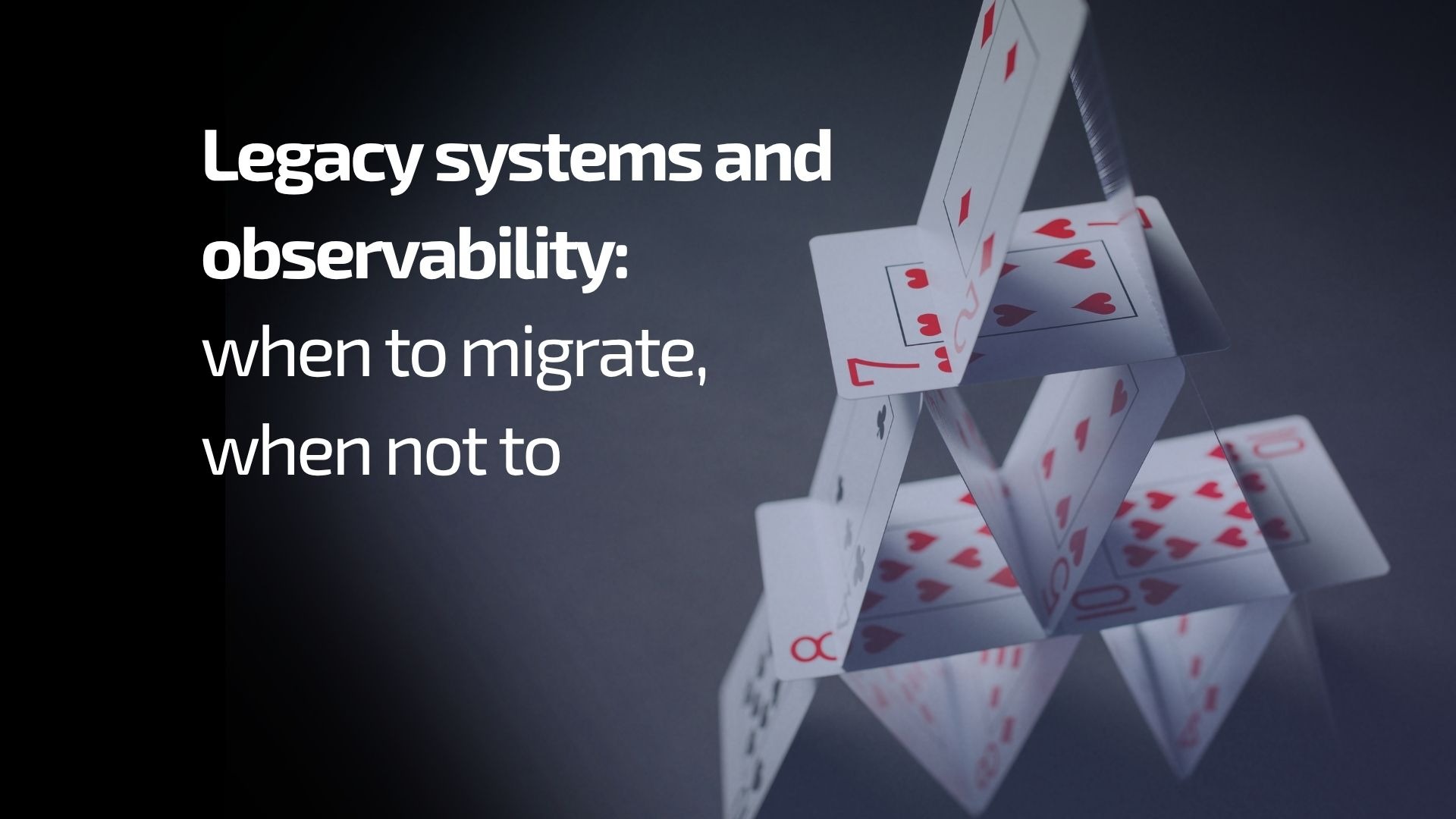
Observability makes this possible: the cards in the house of cards can finally be named. Which is critical, which is replaceable, which can be touched — and which cannot. AIOps solutions go further: they automatically filter out the noise and draw attention only to what requires real action.
Telvice Zrt. observability experts help map existing systems, identify real risks, and make well-founded migration decisions on a sound business basis. Request a free consultation!
Sources:
- Dynatrace – Modernize legacy applications with full-stack observability https://www.dynatrace.com/news/blog/modernize-legacy-applications/
- Dynatrace – How to reduce technical debt with observability https://www.dynatrace.com/news/blog/technical-debt-observability/
- Datadog – Observability for legacy systems https://www.datadoghq.com/knowledge-center/observability/
- XXXLutz esettanulmány – Dynatrace end-to-end observability legacy és modern rendszereken https://www.dynatrace.com/news/customer-stories/xxxlutz/
