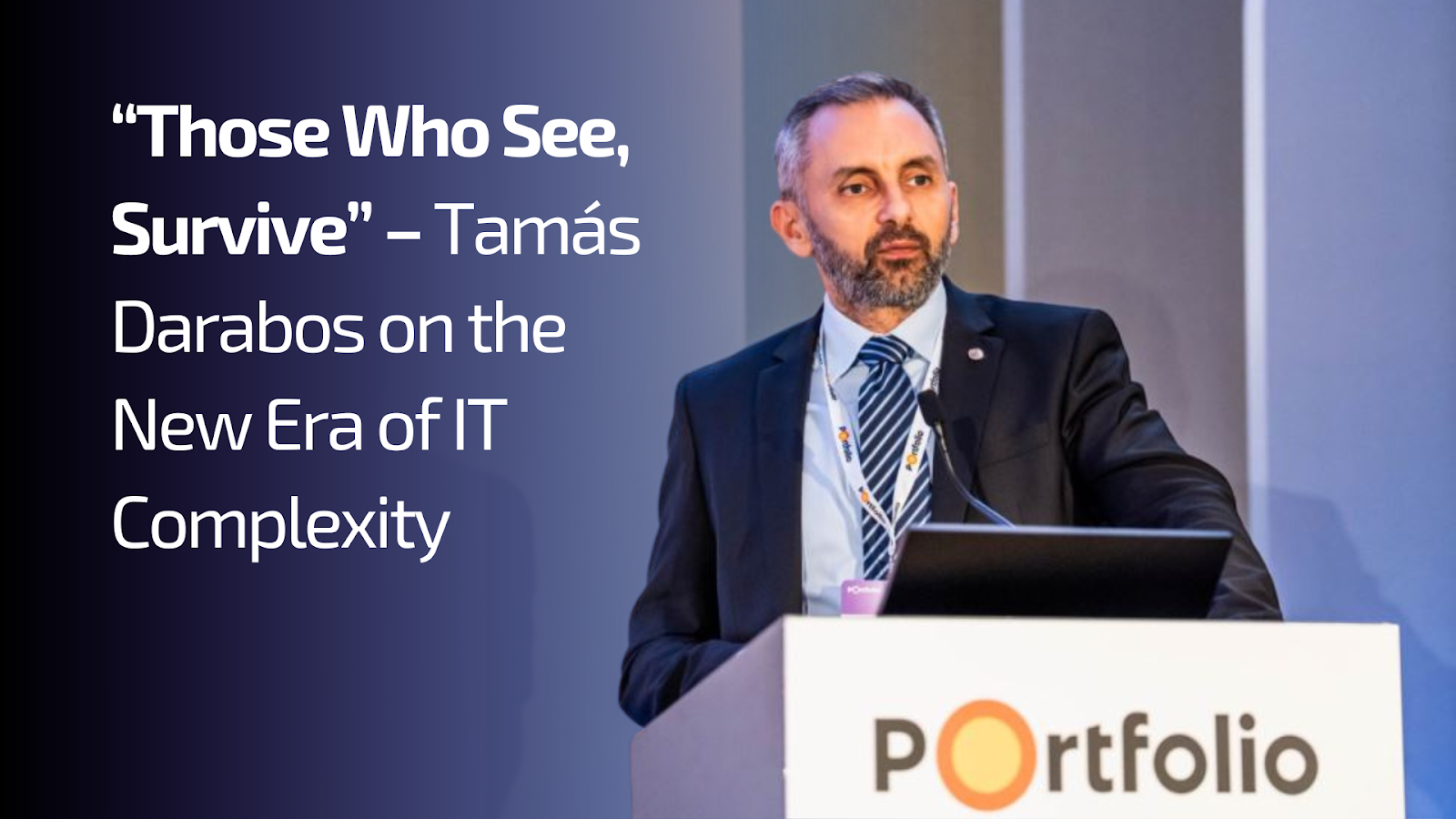
At the Portfolio AI & Digital Transformation 2025 conference, the key players of Hungary’s digital ecosystem once again took the stage. Among leading voices in technology, banking, and telecommunications, Tamás Darabos, Deputy CEO of Telvice, delivered a talk that goes straight to the heart of how enterprises operate today:
the explosion of IT complexity and the paradigm shift it forces upon organizations.
His presentation was both a diagnosis and a call for a new mindset—one that makes it possible to control a digital ecosystem that has grown far beyond human cognitive limits.
A New World in Just a Decade
In the past ten years, IT environments have not simply grown—they have expanded exponentially. Microservices, hybrid cloud, API chains, CI/CD pipelines, automation layers, and AI-driven components have all stacked onto each other, creating unprecedented system depth.
A decade ago, every major bank and enterprise still had that one expert who “knew the system.”
They understood how components connected, where weaknesses lived, and whom to call when things went wrong.
Today, such a person no longer exists.
Not because expertise is lacking, but because the system grows faster than any human can comprehend.
Meanwhile, the role of IT has fundamentally changed.
IT is no longer a supporting function in the background—it has become the heartbeat of the business.
Whether organizations acknowledge it or not, every enterprise has become a technology company.
A single IT slowdown or outage can jeopardize business continuity, making the stability of the IT ecosystem absolutely critical.
The Illusion of Control
On the surface, enterprise IT looks controlled and well-managed.
Dashboards are filled with data, KPIs are green, SLAs are met, reports are delivered, PI plannings run on schedule, and incident calls follow the playbook.
On paper, everything is fine.
Yet when a critical service slows down or fails, the same scene plays out:
a hastily assembled war room, ten to twelve teams on one call, each bringing their own datasets.
Network metrics point to a network issue.
Database graphs point to a database issue.
Application dashboards point to the application.
Each perspective is partially true—and none tells the whole story.
Tamás called this “the illusion of control”:
“We have an abundance of information, but a shortage of understanding.”
Monitoring shows what is happening.
The real question is why it happens, and how the impact propagates across the ecosystem.
Graphs, metrics, and alerts cannot answer this alone.
Without relationships, context, and real-time interpretation, systems may be visible—but they are not understandable.
The Symptom: Reactive Operations
For years, reactive operations were considered adequate:
agility, firefighting, quick response.
But complexity now generates issues faster than humans can detect them.
Operations fall behind.
Incidents cascade through interconnected systems.
This leads to a critical realization:
Reactive operations are no longer sustainable.
The Paradigm Shift
The core message of Tamás’s keynote was clear:
Traditional monitoring has reached its limits.
Organizations no longer need more visibility. They need better understanding of what they’re already seeing.
This evolution is the next stage of IT maturity:
Monitoring → Observability
Data → Context
Reaction → Anticipation
Seeing → Understanding
Observability is not “better monitoring.”
It is a fundamentally new operational paradigm.
When Systems Begin to Interpret Themselves
As complexity grows, human cognitive capacity becomes the bottleneck.
No enterprise can manually track:
- millions of telemetry signals,
- thousands of microservices,
- hundreds of API chains,
- dozens of cross-functional teams.
This is no longer a human-scale task.
This is where AI enters as the interpretation layer.
AI uncovers causal relationships and system behaviors that humans can no longer map.
It restores leadership’s ability to maintain control over an increasingly dynamic IT ecosystem.
Observability in Practice
Modern IT is not a static architecture.
It is a living, dynamic system—constantly evolving, constantly adapting.
To operate it effectively, enterprises need an observability platform that functions as a learning, self-correcting, predictive digital ecosystem.
Tamás referred to this as:
“the digital immune system.”
The Outcomes:
- fewer incidents,
- shorter mean-time-to-recovery,
- more stable performance,
- accurate capacity and load modeling,
- significantly improved user experience,
- and a rare but invaluable benefit:
data-driven trust between IT and the business.
“Those Who See, Survive.”
Tamás closed his presentation with a thought that transcends technology:
“Those who see, survive.
Those who understand what they see—shape the future.”With Telvice’s targeted solutions, IT costs become manageable, operations become transparent,
and enterprises unlock the full value of digitalization—securing long-term resilience and competitiveness.